Pentimentolism
01
Definition
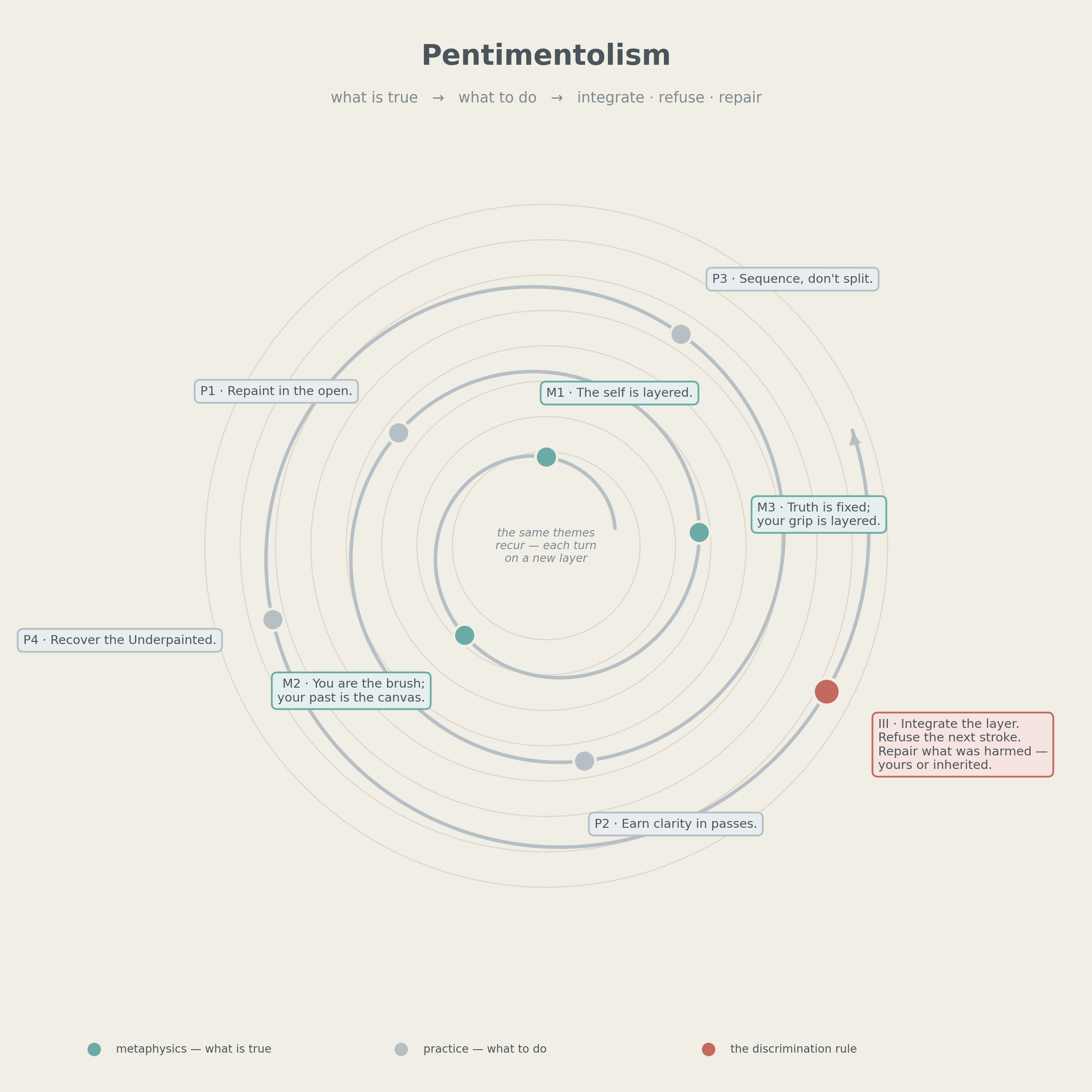
Pentimentolism is the philosophy that the self is a painting in progress: every version of you is a real layer, true when it was made, that persists beneath the next. You become not by erasing the canvas, but by repainting it.
02
What is true
The nature of the self.
M1 The self is layered.
You are not your current version. You are every version, stacked. The earlier ones do not vanish when painted over. They remain beneath the surface, shaping it, the way a pentimento shows through a finished canvas. A past self cannot be deleted. It can only be covered, and a covered layer still bears weight. Layers stack in time. They also fan out in the moment: different modes for different rooms. Same painter, many surfaces.
M2 You are the brush; your past is the canvas.
The brush and the canvas are two different things. The brush is your agency: the live, choosing, painting you. The canvas is the record: every layer already laid down. You act with the brush; you cannot trade in the canvas. You are free to paint, never on a blank surface.
M3 Truth is fixed; your grip on it is layered.
Reality does not change to match your growth. What changes is your clarity: your access to truth is painted in passes, each truer than the last. "Real, but never final" describes your understanding, not the thing understood. The object is fixed; the grip is layered.
03
What to do
What Pentimentolism asks of you.
P1 Repaint in the open.
Revise where the seams show. Do not hide your pivots, your earlier beliefs, the version of you that was wrong. The visible trace is not failure. It is the evidence that you are honest. A repainting done in secret is only a performance of consistency.
P2 Earn clarity in passes.
Do not wait for certainty before you act, and do not counterfeit it. Clarity is not received; it is worked toward, through action, reflection, and revision. Treat every belief as a draft: hold it firmly enough to act on, loosely enough to repaint.
P3 Sequence, don't split.
When two versions of you seem to contradict, do not disown one to keep the other. You were not wrong to be who you were. Across time, arrange them in sequence: you were that, then you became this. Across rooms, arrange them by the painter: same brush, different surfaces. Identity stays whole when its layers are held. It fractures when they are forced to compete.
P4 Recover the underpainted.
Sometimes the surface has drifted from a layer that was truer. Not the earliest layer; the truest. Your history has milestone layers: moments of being most yourself, scattered across the years with drift between them. When the current stroke has wandered, find the milestone underneath and paint forward from it. The pentimento is not only what you carry. When you need it, it is also what you steer by. (Truer to your own intent, not metaphysically. M3 still holds; the object does not move.)
04
The discrimination rule
When to integrate, when to refuse, and when to repair.
Not everything should be kept the same way. A layer is what you were. A pattern is what you keep doing.
The brush tells you which is which. The story does not. A pattern becomes a layer only when you have stopped painting it, not when you have stopped speaking of it. If others cannot see the change, the change has not happened yet.
From this, three movements:
Integrate every layer. Refuse the next stroke of a pattern. Repair where the layer caused harm.
Integrate.
A layer cannot be undone. What makes a layer dangerous is not the fact of it but the hiding of it. Concealment turns a layer into shame. So every layer is named, owned, allowed to show.
Refuse.
A pattern is still moving, and a pattern can do harm. Here Pentimentolism says no, but precisely. You cannot erase a pattern; its past strokes are already layers. What you can do is lift the brush. Lift it visibly: a pattern stopped while its history is hidden is the clean break in disguise.
Repair. A layer cannot reach the person it marked; its consequences can. Where a past act still runs in another's life, integration is necessary and insufficient. You owe a movement outward: an acknowledgment, an amends, the wound tended where it still bleeds. Integration is what you do for yourself. Repair is what you do for them.
Inherited Repair. A canvas can be inherited. When the surface you paint on was meaningfully shaped by a pattern that marked others (a lineage, a tradition, a name, a position), and the wound still runs in the marked or their descendants, the new painter inherits a transferred form of Repair: acknowledge the harm without deflecting ("I did not do that" is true and insufficient); refuse to extend the pattern; and offer what restoration is in your power, scaled to your proximity and means. You did not paint the wounding stroke. You are working on the canvas it scarred. Tend it where it still bleeds, even if you did not open it.
The brush lifts. That is the only erasure there is.